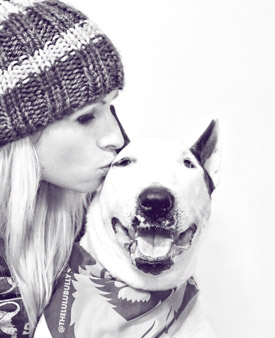
A BEAUTIFUL BULLY MIND
Tips for healthy play, solid boundaries, a balanced mind and a happy life with your Bully!
The Toddler in a Dog Suit
If you have spent any time around a Bull Terrier, you will have heard the expression: “a toddler in a dog suit.” It is perhaps the single most accurate description of the breed ever coined. Like a toddler, the Bull Terrier is curious about everything, fearless to the point of recklessness, emotionally intense, easily bored, and capable of astonishing feats of creative destruction when left to its own devices.
Also like a toddler, the Bull Terrier is watching you. Constantly. Learning from you. Testing you. Figuring out what it can get away with. And, most importantly, looking to you for guidance, structure and reassurance. This is the key to understanding the Bull Terrier mind: they are extraordinarily intelligent, deeply sensitive and profoundly attuned to their human companions. They need leadership, not just love.
Pack Leadership
The Bull Terrier needs to know where it stands in the family hierarchy, and it needs to know that you are in charge. This is not about dominance in the outdated, alpha-wolf sense of the word. It is about providing calm, consistent, fair leadership that gives your dog a clear framework within which to operate.
A Bull Terrier without leadership is an anxious Bull Terrier. And an anxious Bull Terrier is a Bull Terrier that will take matters into its own paws — often with results that involve your sofa cushions, your favourite shoes, or the plasterboard walls of your home.
Establish rules early and stick to them. Be consistent — if something is not allowed, it is never allowed, regardless of how cute those big brown eyes look. Everyone in the household must enforce the same rules. Bull Terriers are masters at identifying the weakest link in the family chain of command and exploiting it mercilessly.
Setting Boundaries
Boundaries are not restrictions — they are a gift. A dog that knows the rules is a dog that feels secure. Bull Terriers, in particular, thrive on structure and routine. They want to know what is expected of them, and they take genuine satisfaction in meeting those expectations (even if they occasionally test them, just to make sure you’re still paying attention).
- Meal times: Feed at the same times each day. Make your dog sit and wait before being released to eat. This simple exercise reinforces your position as the provider and leader.
- Doorways and thresholds: You go first. Always. Your dog waits until invited through. This is not about ego — it is about establishing a calm, respectful pattern of behaviour.
- Furniture access: Decide early whether your Bull Terrier is allowed on furniture and stick with it. If yes, it should be by invitation only, and the dog must get down when asked. If no, it is always no.
- Personal space: Your Bull Terrier does not get to demand attention. Nudging, pawing, barking and climbing on you should not be rewarded. Attention is given on your terms, when you choose.
Socialisation
Socialisation is not optional for a Bull Terrier — it is absolutely critical. The window for primary socialisation in puppies closes at around 14 to 16 weeks of age, and the experiences your puppy has during this period will shape its temperament and behaviour for the rest of its life.
A well-socialised Bull Terrier is a confident, relaxed, friendly dog that takes the world in its stride. A poorly socialised one can be fearful, reactive and difficult to manage — a source of stress for both the dog and its owner.
What Socialisation Looks Like
Socialisation means exposing your puppy to as wide a variety of people, animals, environments, sounds, surfaces and experiences as possible, in a positive and controlled way. This includes:
- People of all ages, sizes, ethnicities and appearances — including people wearing hats, sunglasses, uniforms, high-vis vests and carrying umbrellas
- Other dogs of all breeds and sizes — calm, well-socialised adult dogs are ideal role models for puppies
- Other animals — cats, horses, livestock, birds
- Different environments — busy streets, parks, markets, cafes, public transport, the vet’s office
- Sounds — traffic, fireworks, thunderstorms, vacuum cleaners, power tools, children playing
- Surfaces — grass, gravel, sand, metal grates, wet surfaces, stairs
- Handling — being touched all over, having paws held, ears examined, mouth opened, nails trimmed, being groomed and bathed
The goal is not simply exposure, but positive exposure. Every new experience should be paired with calm encouragement, treats and praise. Never force your puppy into a situation it is clearly frightened of — this will only create negative associations. Instead, allow the puppy to approach new things at its own pace, rewarding bravery and curiosity.
Breed-Specific Training Considerations
Bull Terriers are not Golden Retrievers. They are not Labradors. They are not Border Collies. Training methods that work beautifully with those breeds may fall flat with a Bull Terrier, and understanding why is essential to success.
They Are Not “Stubborn”
Bull Terriers are frequently described as stubborn, and this is both true and misleading. A Bull Terrier is not stubborn in the way a mule is stubborn — digging in its heels and refusing to move. Rather, a Bull Terrier is selectively motivated. It is an extraordinarily intelligent dog that quickly learns to assess whether complying with a request is worth its while. If your training is boring, repetitive or lacks adequate reward, your Bull Terrier will simply opt out.
The key is to make training fun, varied and rewarding. Keep sessions short — five to ten minutes at a time is ideal. Use high-value treats. Incorporate play. Change things up frequently. And above all, maintain your sense of humour — because your Bull Terrier certainly will.
Positive Reinforcement
Positive reinforcement is the only training method that should be used with Bull Terriers. Harsh corrections, physical punishment and aversive tools (prong collars, shock collars, choke chains) are not only unnecessary but actively counterproductive with this breed. Bull Terriers have long memories and are deeply sensitive — a dog that has been punished will become either fearful or resistant, neither of which is conducive to learning.
Reward what you want, redirect what you don’t, and ignore what you can. This simple formula, applied consistently, will produce remarkable results with a Bull Terrier.
Healthy Play
Bull Terriers play hard. Very hard. They are physical, enthusiastic and often completely oblivious to their own size and strength. Play is essential for their physical and mental wellbeing, but it must be managed thoughtfully.
- Tug games are excellent — they satisfy the Bull Terrier’s need for physical engagement and provide a great opportunity to practise impulse control (“drop it,” “take it,” “leave it”).
- Fetch is a staple, though some Bull Terriers are better at the “fetch” part than the “bring it back” part. Patience and high-value rewards will help.
- Puzzle toys and enrichment — Kongs, snuffle mats, treat-dispensing toys — are invaluable for keeping the Bull Terrier mind engaged. A mentally stimulated Bull Terrier is a happy Bull Terrier.
- Rough play with humans should be discouraged, especially with puppies. It teaches the dog that using its mouth and body against people is acceptable, which is a recipe for problems as the dog matures and gains its full adult strength.
A Balanced Mind, A Happy Life
The Bull Terrier is not a dog that half-does anything. It loves with its whole heart, plays with its whole body, and feels with its whole soul. It is a breed that will make you laugh every single day, that will test your patience in ways you never imagined, and that will love you with an intensity that is almost overwhelming.
Give your Bull Terrier structure, consistency, mental stimulation, physical exercise and above all, your time and companionship. In return, it will give you everything it has — which, as any Bull Terrier owner will tell you, is more than you ever thought possible.
The Bull Terrier mind is a beautiful thing. Nurture it, respect it, challenge it and enjoy it. There is nothing else quite like it in the canine world.

ABOUT THE AUTHOR
Lix North | Artist, Illustrator, Photographer. Owned by The Lulu Bully.
I grew up on a farm in rural New Zealand. Forever fond of my gumboots and jumping in muddy puddles, my childhood best friends were the farm working dogs (huntaways, bearded and border collies) and the family spaniels. Animals have always been an intrinsic part of my life, I spent a lot of my youth caring for farm and domestic animals, hand rearing orphaned animals and watching and assisting farm hands and vets. One of my earliest memories is the magic and awe I felt as a toddler watching my grandmother help a litter of puppies into the world. As legend has it, my first word was ‘woof’.
As an artist and photographer I seek the imperfections that make each of us, each fleeting moment, and the world around us, utterly unique. I strive to capture our points of difference, our foibles and eccentricities, our daydreams and delusions, our innate temporality - I believe that in the juxtaposition of wonderful strangeness lies an exquisite, honest beauty far greater than that built on pure symmetry, calculable balance or flawlessness. Who better as my muse than a Bull Terrier - the very embodiment of wonderful strangeness.
For fine art by Lix North visit www.lixnorth.com. For illustration, graphic art and photography visit www.lixcreative.com
Disclaimer: The content on lulubully.com is a fluid, living collection of notes, personal thoughts and experiences. I regularly edit tweak and update these blog pages as my ideas evolve. All opinions are my own and are not intended to diagnose, treat, cure, nor prevent any disease. Thoughts expressed, information provided and products mentioned are not necessarily approved by any governing body or health professional. I am not a qualified medical, veterinarian or naturopathic practitioner, my thoughts and experiences are offered purely as a layperson. Discretion, common sense and personal responsibility should be employed when applying any of the ideas expressed here to your own personal situation.